What are target formations?
A crucial aspect of the endgame is the transition from the moving to the flying phase. If White1 wants to win by capturing (rather than by immobilising), he is inevitably forced to reduce Black to three pieces, thereby granting him new movement options. How does he ensure he retains his advantage in doing so? This is particularly relevant in a game with six pieces versus four. Here there are only a few formations that make a win by capturing possible.
A target formation is an arrangement of white pieces containing a closed mill which allows White to force a win, if Black has only three pieces left (and White has more than three2) and if the conditions, that depend on the strength level3 of the target formation, are met.
An exit formation is an arrangement of pieces from which a target formation can be created in a single move, typically by closing a mill.

Above is an overview of all 6-piece target formations (Fig. 1). 4 There are exactly 37 of them, excluding reflections and rotations. White must have reached one of these once he has captured Black’s fourth piece, or else he does not have a forced win. Additionally, certain conditions, depending on the strength level of the target formation, must be met. Target formations are categorized as: „Strong“ (4 of 37, marked with an upper-case „S“ in the overview for German „stark“), „Weak“ (27 of 37, unmarked), and „Extra-Weak“ (6 of 37, marked with a lower-case „xs“ in the overview for German „extra-schwach“). The stronger the formation, the fewer conditions regarding the placement of Black’s pieces need to be met5, and the weaker it is, the more conditions apply.
For strong target formations, the critical points6 must be unoccupied (highlighted in color on the diagrams).
For weak target formations, all conditions for strong formations must be met, and additionally, the opponent must not be able to immediately form a mill.
For extra-weak7 target formations, all conditions for strong and weak formations must be met, and additionally, the opponent must not be able to immediately occupy one of the critical points with a simultaneous mill threat.
Apart from this, the black pieces may be positioned however desired.
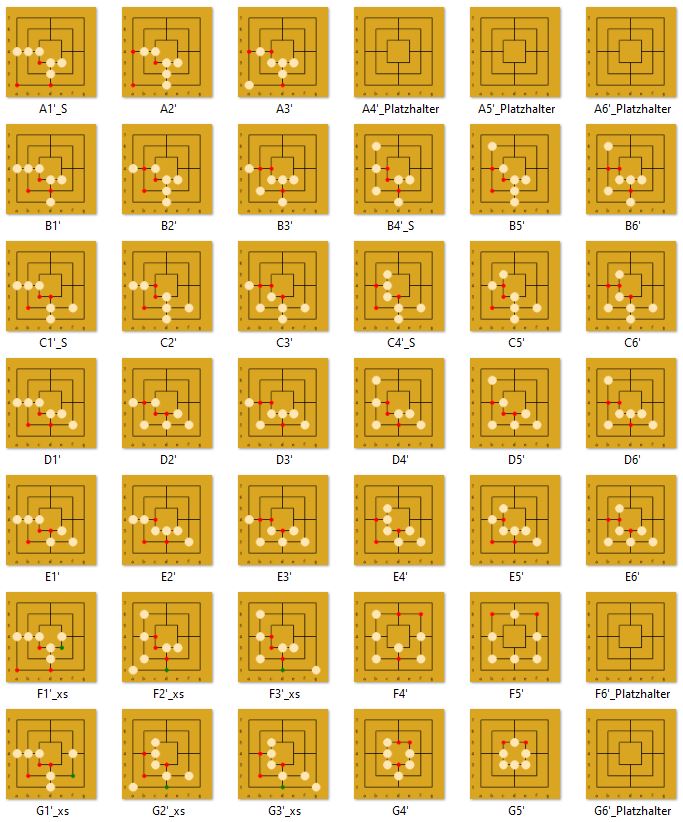
Overview of all 6-piece target formations, reflected over the middle ring (Fig. 2), without any other reflections or rotations. Note that diagrams F5 and F5′ are identical, as each is its own reflection across the middle ring. Together with the diagrams from Fig. 1, this results in a total of 73 distinct diagrams.
A note concerning the translation: The terms „target formation“ and „exit formation are provisional. I’m not quite confident that they capture all the connotations of the German terms „Zielformation“ and „Ausgangsformation“. The term „Ziel“ can also be translated with „destination“, „goal“, „end“, all capturing aspects of the German term, but not fully. Likewise for „Ausgang“, which also carries aspects of „departure“, „start“. When I came up with the terms out of necessity I did not consider the need to translate them one day. Maybe I’ll be able to find better terms.
1 Here, „White“ stands for the attacker and „Black“ for the defender.
2 For the time being, I have decided against including 3-piece target formations in the definition; hence the parenthetical note.
3 My classification of strength levels is based, with some modifications, on the one found in Dr. Rainer Rosenberger’s Mühle Lehrbuch (v1.9, pp. 32 ff.). My „strong“ category combines Rosenberger’s „moderately strong“ and „strong“ categories, while my „weak“ category is identical to his „weak“ category. I have added „extra-weak“ and „extra-strong“ categories, though the latter appears only with 7-piece target formations, not 6-piece ones.
4 7-piece target formations will be covered in a future article.
5 For „extra-strong“ target formations, there are no conditions at all regarding the placement of the opponent’s pieces.
6 They can also be referred to as „disruption points“, a term favored by Erol Özdemir.
The critical points represent the maneuvering space needed to realize the threats inherent in the formation; conversely, that realization can be disrupted at precisely these points.
7 „Extra-weak“ target formations can also be referred to as „delayed-strong“, because it takes only one move to transform them into strong target formations.
Schreibe einen Kommentar